MAHI NĀ ʻAI, ULU KA PILINA
Cultivating Food, Growing Relationships Across the Pacific
Cultivating Food, Growing Relationships Across the Pacific
On Hawaiʻi Island, you can move through multiple worlds in a single day, from coffee farms clinging to volcanic slopes to ranching communities shaped by paniolo traditions; from immersion classrooms humming with ʻōlelo Hawaiʻi to kitchens where stories are carried by hand and heat. What’s far less common is making that journey with people who instinctively understand that food is never just food, and land is never just land.
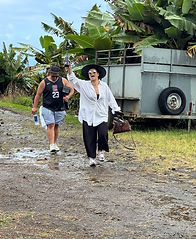
In early December, a five-member Māori delegation from Aotearoa spent eight days traveling across Hawaiʻi Island as part of Mahi Nā ʻAi, Ulu Ka Pilina, a cultural, agricultural, and culinary exchange grounded in a deceptively simple idea: cultivate the foods, grow the relationships.
What still makes me smile is how this all started.
Earlier this year, while in Wellington for work meetings, I stopped by
Wellington Seamarket on my way back to the hotel. Punnets of kina
- sea urchin - sat in the window. I’d been following and fanning
over several Māori food storytellers on social media, and suddenly
there it was: the bounty of their ocean, right in front of me. I
grabbed some kina, a bottle of champagne from Woolworth’s
(not my beloved Perrier-Jouët, but it would do), and went back to my
room to enjoy the briny, creamy goodness.
I posted an Instagram story and tagged Raukura Huata, whose
work unapologetically elevates Māori food, through plating, pairing,
fashion, storytelling, however she chooses to tell it. “Stockpiling at
@wellingtonseamarket trying to live my best @raukurahuata life,” I wrote.
She responded.
So I did the next very Hawaiian thing: I invited her to eat with us.
I was traveling around Aotearoa for two weeks, and we told her we’d
be in Taranaki. She joined us. I cooked a bunch of food. We talked. We shared. She came back the second night, this time with friends. Somewhere in the middle of that moment, Kaʻiu Kimura, Director of Hawaiʻi ʻImi Loa at the University of Hawaiʻi at Hilo, said she’d love to bring our new food storyteller friends to Hawaiʻi. Working with Brandon Lee and Chef Keoni Regidor of Lehua Restaurant at ʻImiloa, she said, we could really do something meaningful.
That moment became an invitation.
The invitation became a plan.
And the rest, honestly, became something none of us could have predicted. At the time it felt spontaneous, but in hindsight it was inevitable.
What began as a simple Instagram tag grew into something deeper than any one of us imagined.
The exchange drew public attention through a series of HI Now Daily segments that framed the week as a celebration of culinary connection and cultural exchange between Māori and Native Hawaiian communities. But the real story unfolded off-camera, in kitchens, fields, classrooms, and long conversations that stretched late into the evening.
What emerged wasn’t an event or a program. It was a reconnection - one that felt less like creating something new and more like remembering something old.
A Hui of Storytellers
Mahi Nā ʻAi, Ulu Ka Pilina brought together a collective of educators, chefs, cultural practitioners, storytellers, and communicators from Hawaiʻi and Aotearoa, people whose work is rooted in land, language, and relationship. From Hawaiʻi, that included Kaʻiu Kimura of Hawaiʻi ʻImi Loa; chefs Brandon Lee and Keoni Regidor of Nāpua and Lehua Restaurants; kumu Kaimana Kawaha of Ka ʻUmeke Kā‘eo Public Charter School; ʻōlelo Hawaiʻi advocates and storytellers Amy Kalili, Kayla Lindsey-Asing, and Kapuaonaona Roback; and me, wearing my hat as a strategic communications consultant and President and CEO of Pae ʻĀina Communications and The Island Agency. Together, we grounded the exchange in ʻāina-based practice, Indigenous education, culinary collaboration, and community stewardship - centering students, relationships, food systems and our home as the work itself.
Joining us from Aotearoa was a Māori delegation whose practices mirror and complement what we’re doing here: food storyteller Raukura Huata; photographer and storyteller Te Rawhitiroa Bosch; environmental and mahinga kai practitioner Te Ata Tuhimata; food editor and journalist Charlotte Muru-Lanning; and chef and gatherer Dusty Marley Robson. Over nine days, we moved together through farms, kitchens, classrooms, and sacred landscapes, sharing meals, knowledge, responsibility, and time. What formed wasn’t just collaboration. It was kinship, strengthened across Moananuiākea through the everyday, profound act of cultivating food and growing relationships.
A Week That Moved With the Land
The itinerary was ambitious by design. We moved deliberately through Kona’s coffee belt and ocean science corridor, Waimea’s ranching country, Hāmākua’s farms, Hilo’s cultural and educational centers, and the volcanic landscapes that continue to shape Hawaiʻi Island’s identity.
Every place became a lesson, not just in agriculture or cuisine, but in worldview. Food was our common language, inseparable from land stewardship, language revitalization, and cultural responsibility.
At Hawaiʻi ʻImi Loa, the exchange found a natural anchor. Kaʻiu shared something that stayed with me: as Hawaiʻi faces urgent questions about food security and sustainability, solutions don’t begin in boardrooms or policy papers. They begin in relationships.
Kitchens as Cultural Ground
So much of the exchange unfolded through shared meals and collaborative cooking. Raukura worked alongside Keoni and Brandon, whose practices are deeply rooted in relationships with farmers, ranchers, and fishers. Their collaboration wasn’t about technique - it was about orientation.
“Kai carries whakapapa,” Raukura said. “When we cook together, we’re not just feeding people, we’re transmitting knowledge.”
Students from Ka ʻUmeke Kā‘eo hosted, cooked, and welcomed us, turning their campus into a living classroom. Kaimana spoke about how important it was for haumāna to see Māori cousins doing the same work - reclaiming food, language, and knowledge systems.
Meals became moments of recognition. Ingredients unlocked memories. Laughter came easily. Vulnerability followed. The pace slowed.
Privilege, Challenge, and Honesty
There was also a quiet understanding throughout the week: being able to gather like this, to pause, to travel, to reflect, is a privilege. We didn’t ignore that.
We talked openly about colonization, biosecurity, climate pressure, and the fragility of island food systems. We didn’t try to solve those challenges in a week. We sat with them, together.
Charlotte reflected on how food holds stories of labor, power, and loss, but also continuity. Te Rawhitiroa captured the moments in between: hands in soil, students listening, the stillness before a meal. His work understood what many of us felt - that trust lives in the quiet spaces.
More Than a Media Moment
While HI Now Daily framed Mahi Nā ʻAi, Ulu Ka Pilina as a week of culinary connection and cultural exchange, the experience itself resisted tidy summarization.
By the final days, formality had fallen away. We stopped talking about collaboration and started talking about cousins, not metaphorically, but genuinely.
The exchange culminated in a community ʻahaʻaina at Lehua Restaurant. There were speeches and gratitude, but no sense of closure.
Because this wasn’t an ending.
Gratitude and Forward Momentum
None of this would have been possible without the support of partners who understood that this exchange was rooted in care, trust, and responsibility. The County of Hawaiʻi, Grand Naniloa Hotel, Hawaiʻi ʻImi Loa - including Ka Haka ʻUla O Keʻelikōlani, the College of Hawaiian Language, and the ʻImiloa Center - along with Alaska Airlines and Hawaiian Airlines, Hawaiʻi News Now, and especially Nāpua and Lehua Restaurants, made it possible for us to host with intention. Their generosity created the space for people to slow down, gather, and build real relationships — allowing this work to unfold in a way that honored place, culture, and the deep connections we were there to strengthen.
I am overwhelmed with gratitude and especially thankful to Kaʻiu, Amy, Kapua, Kayla, Brandon, Keoni, Kaimana and the seen and unseen kūpuna that made this happen.
Mahi Nā ʻAi, Ulu Ka Pilina was never meant to be a solution or a model to copy without care. What it offered was a reminder: Indigenous resilience has always depended on relationships, across land, across ocean, across generations.
As Hawaiʻi navigates climate pressure and long-term food security questions, this exchange quietly re-centered what truly sustains island societies: cultural knowledge, intergenerational practice, and community networks grounded in reciprocity.
When people cook together, harvest together, and learn from one another, they remember what feeds them.
Across Moananuiākea, those ties weren’t created during this exchange.
They were restored. Ua kō!